
The United States Air Force (USAF) has a rich history, evolving from its roots in early aviation to becoming a dominant force in global air and space operations. Here’s an overview of the history of the United States Air Force:
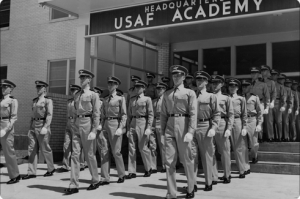
History of the United States Air Force
-
Table of Contents
ToggleOrigins and Early Years (1907-1947):
- Birth of Aviation: The early 20th century saw significant developments in aviation. The Wright brothers’ first powered flight in 1903 laid the groundwork for military aviation.
- World War I: During World War I, the U.S. Army Signal Corps operated aircraft for reconnaissance and limited combat roles.
- Army Air Corps: In 1926, the Air Corps became a part of the U.S. Army, reflecting the growing importance of aviation in military strategy.
-
World War II (1941-1945):
- Expansion and Independence: The United States Army Air Forces (USAAF) underwent massive expansion during World War II. Strategic bombing campaigns and air superiority played key roles.
- Tactical Innovations: The war saw the development of new aircraft, tactics, and technologies, including the heavy bomber B-17 Flying Fortress and the long-range P-51 Mustang.
- Strategic Bombing: USAAF bombers played a crucial role in strategic bombing campaigns against Axis targets in Europe and the Pacific.
-
Post-World War II and Independence (1947):
- National Security Act of 1947: The National Security Act of 1947 established the United States Air Force as an independent branch of the military, separate from the U.S. Army.
- Cold War Era: The Air Force became a central element of U.S. defense strategy during the Cold War, focusing on strategic bombing, nuclear deterrence, and air superiority.
-
Korean War (1950-1953):
- Air Superiority: The Air Force played a critical role in achieving air superiority during the Korean War, employing jet aircraft in combat for the first time.
-
Vietnam War (1964-1973):
- Aerial Warfare: The Air Force conducted extensive bombing campaigns over North Vietnam and played a significant role in tactical air support for ground forces in South Vietnam.
- Technological Advances: The war saw the introduction of advanced aircraft, including the F-4 Phantom II and the B-52 Stratofortress.
-
Strategic Deterrence and Modernization (1970s-1980s):
- Nuclear Triad: The Air Force maintained a key role in the U.S. nuclear triad, consisting of land-based missiles, strategic bombers, and submarine-launched ballistic missiles.
- Stealth Technology: The development of stealth technology led to the creation of advanced aircraft like the B-2 Spirit bomber.
-
Post-Cold War and Global Operations (1990s-Present):
- Gulf War (1990-1991): The Air Force played a central role in the Gulf War, showcasing precision-guided munitions and air superiority.
- Humanitarian Operations: The Air Force has been involved in various humanitarian and peacekeeping operations worldwide.
-
Space Operations and the U.S. Space Force (2019-Present):
- Establishment of the U.S. Space Force: In December 2019, the U.S. Space Force was established as a separate military branch, responsible for organizing, training, and equipping space forces.
- Space as a Warfighting Domain: The Air Force and the Space Force continue to adapt to evolving threats in the space domain.
The United States Air Force has played a crucial role in shaping military aviation, aerospace technology, and global strategic capabilities, contributing significantly to the nation’s defense and security.

