
Introduction:
Explanatory essays serve a crucial purpose in academic and professional writing by elucidating complex topics, processes, or phenomena to readers. They provide clarity and understanding by breaking down intricate subjects into digestible parts and explaining them in a coherent manner. The effectiveness of an explanatory essay hinges on its structure and the integration of key components, which guide readers through the exploration of the subject matter. In this comprehensive analysis, we will delve into the essential elements and structure of explanatory essays, equipping writers with the knowledge to craft compelling and informative pieces.
Understanding Explanatory Essays:
Explanatory essays, also known as expository essays, aim to inform, clarify, or expound upon a particular topic. Unlike persuasive essays, which seek to persuade the audience to adopt a specific viewpoint, explanatory essays focus on presenting information objectively. Whether elucidating a scientific concept, analyzing a historical event, or exploring a literary work, the primary goal remains consistent: to provide readers with a deeper understanding of the subject matter.
Key Components of Explanatory Essays:
-
Introduction:
- The introduction serves as the gateway to the essay, capturing the reader’s attention and providing essential background information on the topic.
- It typically includes a hook to engage the audience, followed by a thesis statement that succinctly outlines the main idea or purpose of the essay.
- Additionally, the introduction may preview the subtopics or key points that will be addressed in the body paragraphs, offering readers a roadmap for navigating the essay.
-
Body Paragraphs:
- The body paragraphs form the core of the explanatory essay, where the topic is explored in depth and supporting evidence is presented.
- Each body paragraph should focus on a specific aspect or subtopic related to the main idea established in the thesis statement.
- Within each paragraph, writers should provide clear explanations, examples, statistics, or other relevant evidence to elucidate the topic and reinforce the central argument.
- Transition sentences between paragraphs help maintain coherence and guide the flow of ideas from one point to the next.
-
Supporting Evidence:
- Supporting evidence strengthens the arguments presented in the essay and lends credibility to the author’s assertions.
- Examples of supporting evidence include data, facts, quotations from experts, case studies, anecdotes, and empirical research findings.
- It is essential to evaluate the quality and relevance of the evidence, ensuring that it directly supports the main points of the essay and aligns with the intended audience’s level of understanding.
-
Analysis and Interpretation:
- Analysis involves examining the significance of the evidence presented and elucidating its implications for the topic under discussion.
- Writers should analyze the evidence critically, identifying patterns, relationships, or underlying causes that contribute to a deeper understanding of the subject.
- Interpretation involves synthesizing the evidence and offering insights or interpretations that shed light on the topic from a unique perspective.
- Through analysis and interpretation, writers demonstrate their comprehension of the subject matter and provide readers with valuable insights that enrich their understanding.
-
Conclusion:
- The conclusion brings the essay to a close by summarizing the main points and restating the thesis in light of the evidence presented.
- It should not introduce new information but rather reinforce the key arguments and provide a sense of closure to the essay.
- Additionally, the conclusion may offer implications or recommendations based on the findings discussed in the essay, inviting readers to consider the broader significance of the topic.
Structure of Explanatory Essays:
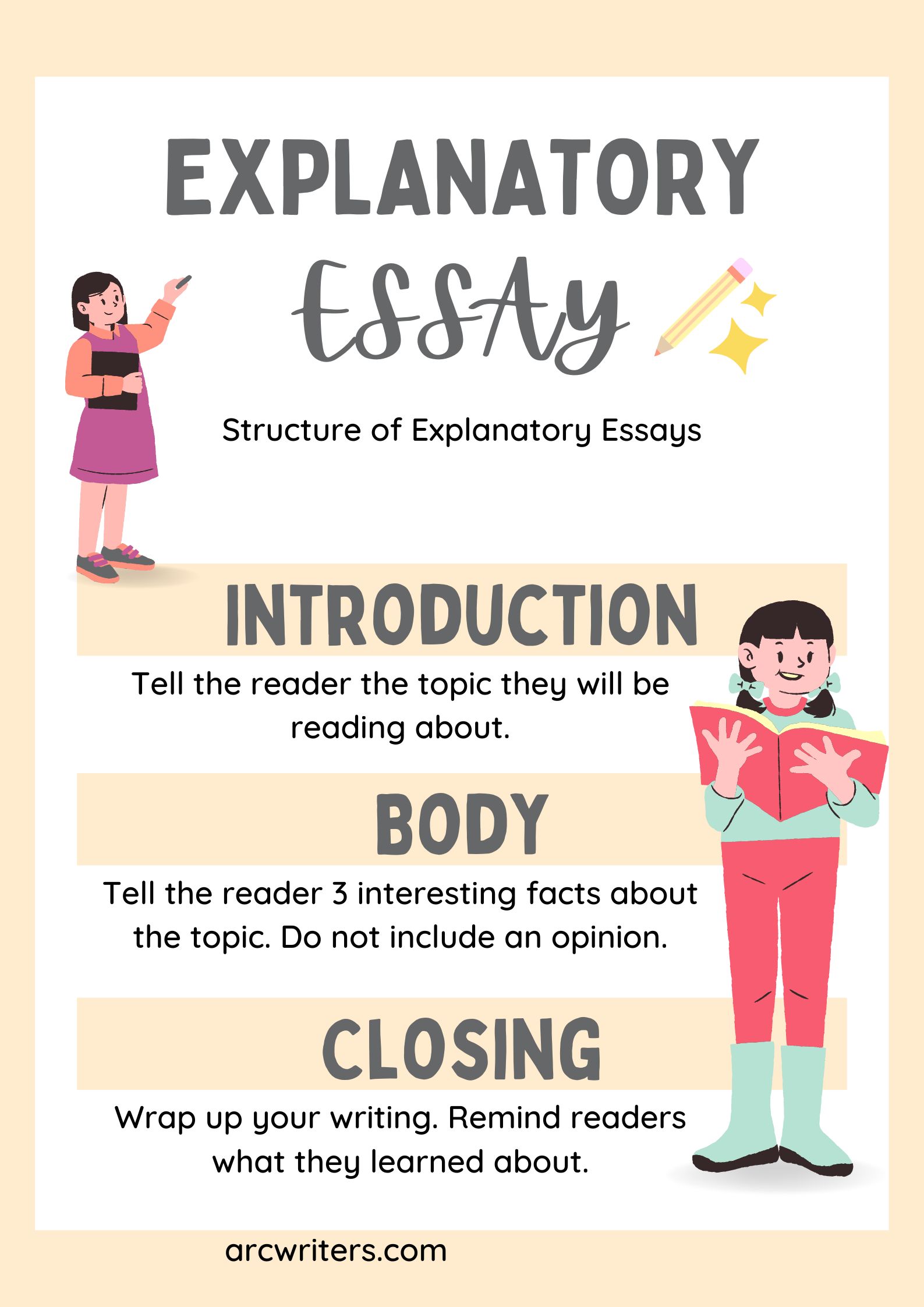
Structure
The structure of an explanatory essay plays a pivotal role in organizing the content and guiding readers through the exploration of the topic. While there is flexibility in the structure of essays, a common approach involves the following framework:
-
Introduction:
- Hook: Engage the reader with a compelling opening statement, question, or anecdote that piques their interest.
- Background Information: Provide context or background information on the topic to orient the reader.
- Thesis Statement: Clearly state the main idea or argument of the essay, outlining what will be covered in the subsequent paragraphs.
-
Body Paragraphs:
- Topic Sentence: Introduce the main idea or subtopic of the paragraph.
- Supporting Evidence: Present evidence, examples, or explanations to support the topic sentence.
- Analysis: Analyze the significance of the evidence and its relevance to the main argument.
- Transition: Use transition words or phrases to smoothly connect ideas between paragraphs.
-
Conclusion:
- Restate Thesis: Summarize the main argument or thesis statement, emphasizing its significance.
- Summary of Main Points: Recap the key points discussed in the body paragraphs, highlighting the most important findings.
- Final Thought: Offer a concluding thought, reflection, or implication related to the topic.
Strategies for Crafting Compelling Explanatory Essays
- Conduct Thorough Research: Gather relevant information, data, and sources to support your explanations and arguments. Consult scholarly articles, books, reputable websites, and academic databases to ensure accuracy and credibility.
- Maintain Objectivity: Present information objectively without bias or personal opinion. Use evidence-based reasoning and logical analysis to support your claims and assertions.
- Clarify Complex Concepts: Break down complex ideas into simpler terms and provide clear explanations. Use analogies, examples, and visual aids to enhance comprehension and engagement.
- Use Clear and Concise Language: Communicate ideas clearly and concisely, avoiding unnecessary jargon or technical language. Use plain language that is accessible to your target audience.
- Revise and Edit: Review your essay carefully for clarity, coherence, and consistency. Check for grammatical errors, spelling mistakes, and factual inaccuracies. Seek feedback from peers, instructors, or writing tutors to improve your essay.
Conclusion:
Explanatory essays are invaluable tools for imparting knowledge, clarifying complex subjects, and fostering understanding among readers. By integrating key components such as a clear thesis, well-supported arguments, and logical structure, writers can effectively convey information and engage audiences in meaningful exploration. Understanding the components and structure of explanatory essays empowers writers to craft compelling narratives that inform, enlighten, and inspire. As writers continue to refine their skills in crafting explanatory essays, they contribute to the dissemination of knowledge and the advancement of structure discourse in diverse fields of study.
