
Table of Contents
ToggleIntroduction
Explanatory essays serve a crucial purpose in conveying information, clarifying concepts, or elucidating complex ideas. However, the effectiveness of these essays greatly depends on how well they are organized. A well-structured essay enhances readability, coherence, and overall understanding for the reader. One of the fundamental aspects of essay organization lies in the arrangement of paragraphs. This guide aims to delve deep into the art of effectively organizing explanatory essay paragraphs, providing strategies and techniques to help writers craft compelling and coherent essays.
Understanding the Purpose of Paragraphs:
The purpose of paragraphs in an essay is multifaceted, serving as essential building blocks that contribute to the overall structure and coherence of the piece. Each paragraph is crafted to encapsulate a singular main idea or aspect of the topic, providing a focused exploration that aids in comprehension. By organizing information into distinct units, paragraphs enable writers to present arguments, evidence, and analysis in a systematic manner, facilitating clarity and logical progression.
Furthermore, paragraphs serve as effective tools for guiding the reader through the essay, offering signposts that delineate shifts in topic or argumentation. Ultimately, the purpose of paragraphs is to enhance readability, coherence, and understanding, ensuring that the essay effectively conveys its intended message to the audience.
Establishing a Clear Structure:
-
- Begin with an introductory paragraph that sets the stage, presents the thesis statement, and outlines the main points to be discussed.
- Follow with body paragraphs, each addressing a specific aspect or subtopic related to the thesis.
- Conclude with a summary paragraph that reinforces the main points and provides closure.
Employing the P.E.E.L. Method:
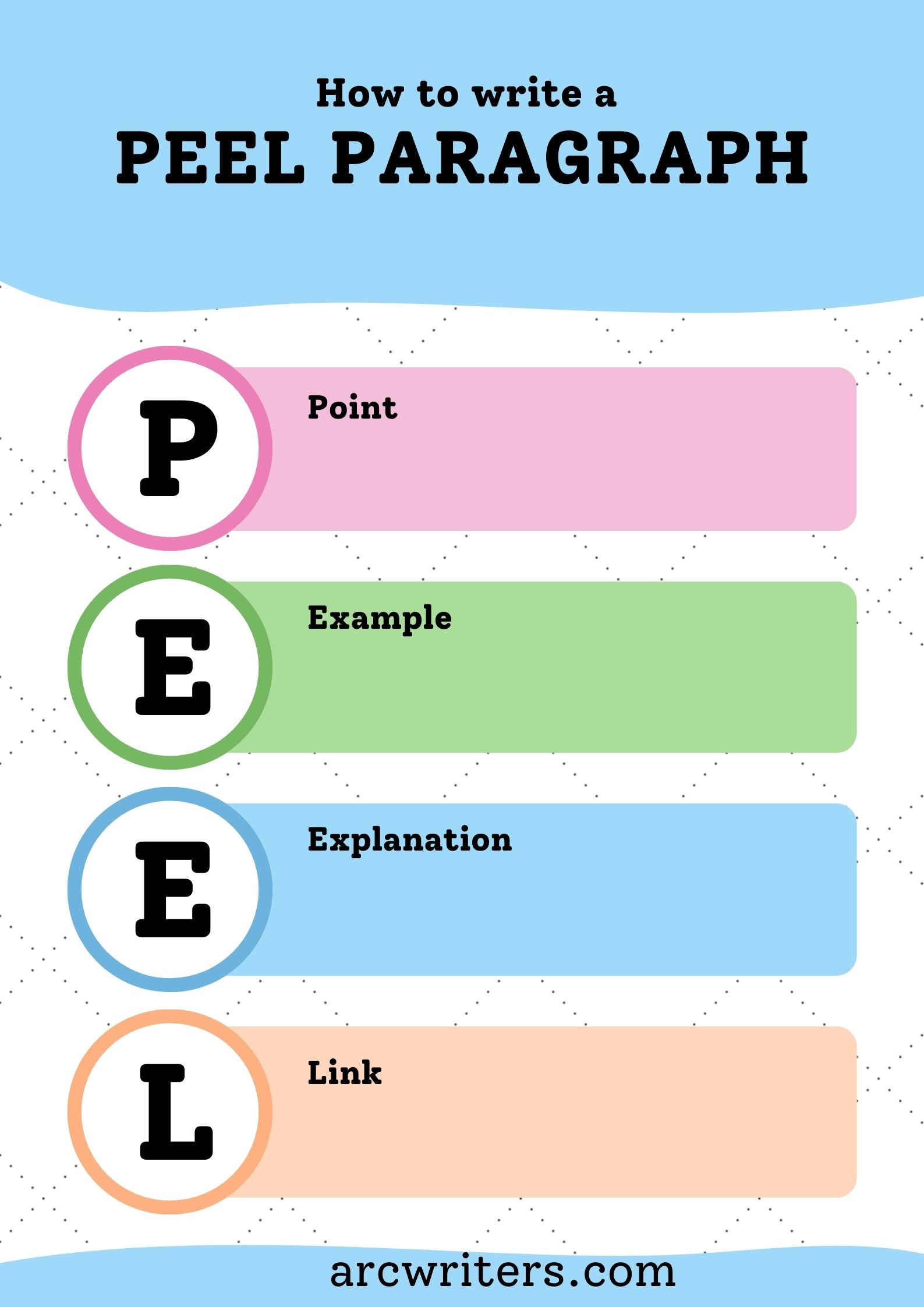
paragraphs
Employing the P.E.E.L. method in essay writing is a strategic approach to crafting well-structured paragraphs that effectively convey ideas and arguments. P.E.E.L. stands for Point, Evidence, Explanation, and Link, providing a clear framework for paragraph organization. Each paragraph begins with a concise topic sentence or point that introduces the main idea to be discussed. Following this, evidence is presented to support the point, which may include quotes, data, or examples.
Subsequently, the writer provides an explanation of how the evidence supports the main idea, offering analysis and insight into its significance. Finally, the paragraph is concluded with a link back to the essay’s thesis or overarching argument, ensuring coherence and reinforcing the relevance of the point within the broader context of the essay. By adhering to the P.E.E.L. method, writers can create paragraphs that are cohesive, logical, and persuasive, thereby enhancing the overall effectiveness of their essays..
Organizing Paragraphs Logically:
Organizing paragraphs logically is a fundamental aspect of crafting a coherent and engaging essay. A logical organization ensures that ideas flow smoothly from one paragraph to the next, allowing the reader to follow the argument or narrative seamlessly. One effective method for organizing paragraphs logically is to consider the structure of the essay as a whole and arrange paragraphs in a manner that enhances comprehension and builds upon previous points. Depending on the nature of the topic, paragraphs can be organized chronologically, spatially, or according to the order of importance.
Chronological organization may be suitable for essays discussing historical events or processes, while spatial organization may be more appropriate for essays describing physical locations or phenomena. Additionally, ordering paragraphs by importance allows writers to prioritize key points and ensure that they receive the appropriate emphasis. Transition words and phrases can be used to connect paragraphs and signal shifts in topic or perspective, further enhancing the coherence of the essay. By carefully organizing paragraphs in a logical manner, writers can create essays that are both easy to follow and intellectually satisfying for the reader.
Incorporating Signposting:
-
- Use transitional phrases or signposts to guide the reader through the essay.
- Words and phrases like “firstly,” “in addition,” “furthermore,” and “conversely” help signal shifts between paragraphs and ideas.
- Signposting enhances clarity and ensures that the reader can easily follow the progression of the argument.
Balancing Unity and Coherence:
Balancing unity and coherence within each paragraph is crucial for crafting effective and compelling essays. Unity refers to the idea that each paragraph should focus on a single main idea or aspect of the topic, ensuring clarity and preventing confusion for the reader. Coherence, on the other hand, refers to the seamless flow of ideas within a paragraph, as well as its connection to the broader context of the essay. Achieving this balance requires writers to carefully select and develop supporting details that directly relate to the main idea of the paragraph, while also ensuring that transitions between sentences and ideas are smooth and logical.
Varying Sentence Structure:
Varying sentence structure within each paragraph is a key technique for maintaining reader engagement and enhancing the overall quality of an essay. A diverse array of sentence structures, including simple, compound, and complex sentences, adds rhythm and fluency to the writing, preventing monotony and monotony that can arise from repetitive structures. By incorporating different sentence types, writers can effectively convey ideas with nuance and depth, capturing the reader’s attention and sustaining their interest throughout the essay.
Moreover, varying sentence structures allows for greater flexibility in expressing complex thoughts and arguments, enabling writers to communicate their ideas more effectively. Additionally, transitions and cohesive devices can be seamlessly integrated within varied sentence structures to ensure coherence and logical flow between ideas. Ultimately, by consciously diversifying sentence structures within each paragraph, writers can create essays that are engaging, dynamic, and impactful.
Providing Clear Transitions:
-
- Effective paragraph organization relies on seamless transitions between paragraphs.
- Use transitional words and phrases to connect ideas and facilitate the logical progression of thought.
- Transitions help bridge the gap between paragraphs, reinforcing the relationship between preceding and subsequent points.
Emphasizing Main Points:
-
- Structure paragraphs in a way that highlights the importance of main points.
- Begin and end paragraphs with strong, impactful sentences that capture the reader’s attention and reinforce key ideas.
- Use repetition and parallelism to emphasize important concepts and enhance memorability.
Seeking Feedback and Revision:
-
- After drafting the essay, seek feedback from peers, instructors, or writing centers.
- Revise and refine the organization of paragraphs based on feedback, ensuring clarity, coherence, and effectiveness.
- Be open to restructuring paragraphs or reorganizing content to improve overall readability and comprehension.
Conclusion:
Mastering the art of organizing explanatory essay paragraphs is essential for crafting compelling and coherent essays. By understanding the purpose of paragraphs, establishing a clear structure, employing effective organization strategies, and seeking feedback for revision, writers can enhance the readability, coherence, and overall impact of their essays. Effective paragraph organization not only facilitates understanding for the reader but also strengthens the writer’s ability to convey information, clarify concepts, and elucidate complex ideas.
