Question 1:
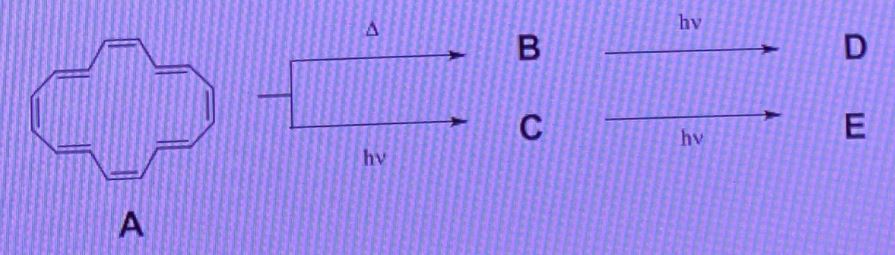
Compound A undergoes a cascade of electrocyclic reactions to give compound B under thermal conditions and C under photochemical conditions. Compounds B and C can undergo a further cycloaddition reaction under photochemical conditions to give compounds D and E, respectively.
Please write the chemical structures of compounds B, C, D, and E. For the cascade of your choice (A-B-D or A-C-E), explain in detail the reaction mechanism. Considering the Woodward-Hoffmann rules and frontier molecular orbital theory to suggest whether the reaction is allowed or forbidden.
Question 2:
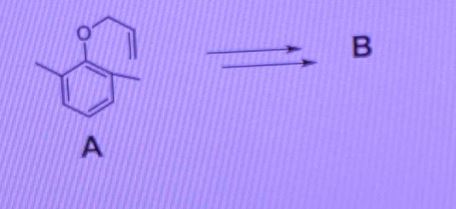
Compound A undergoes a cascade of Sigmatropic rearrangement reactions to give compound B. Write the structure of compound B and all the intermediates leading to B. define the type of Sigmatropic rearrangement reactions in this example, and suggest the driving force for the formation of B.