
A comprehensive history of money and banking in the United States involves tracing the evolution of financial systems, currencies, and banking institutions. This study gives a broad overview of key developments and a history of money and banking in the United States.
A History of Money and Banking in the United States
Table of Contents
ToggleColonial and Early American Period:
- Barter System: In the early colonial period, a barter system was common, where goods and services were exchanged directly.
- Spanish Pieces of Eight: Various currencies circulated, including Spanish silver coins known as pieces of eight.
- Colonial Scrip: Colonies issued their own paper money or scrip to facilitate trade and economic activities.
Revolutionary War and the Articles of Confederation:
- Continental Currency: During the Revolutionary War, the Continental Congress issued Continental Currency. However, due to inflation and lack of backing, it rapidly depreciated.
- Challenges: The financial chaos during the war highlighted the need for a more stable system.
Constitutional Period:
- Coinage Act of 1792: The Coinage Act established the U.S. Mint and regulated coinage. The U.S. adopted the bimetallic standard, linking the value of the dollar to both gold and silver.
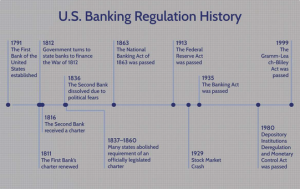
- First Bank of the United States (1791-1811): Alexander Hamilton proposed and established the First Bank to stabilize the economy, manage government finances, and provide a uniform currency.
Jacksonian Era and the Second Bank:
- Opposition to the Second Bank: President Andrew Jackson opposed the Second Bank of the United States, leading to its demise in 1836.
Civil War and National Banking System:
- Greenbacks: To finance the Civil War, the U.S. issued paper money known as greenbacks, which were legal tender.
- National Banking Act (1863): The National Banking System was established to create a uniform banking system with national banks issuing a common currency.
Gold Standard and Bimetallism:
- Resumption Act (1875): The U.S. returned to the gold standard, and the Resumption Act aimed to redeem greenbacks in gold.
- Bimetallism Debates: The late 19th century saw debates over whether to use gold and silver (bimetallism) or adhere strictly to the gold standard.
Federal Reserve System (1913):
- Federal Reserve Act: In response to financial panics, the Federal Reserve System was created to serve as the central banking authority, providing stability and flexibility to the financial system.
Depression Era and Banking Reforms:
- Great Depression: The stock market crash of 1929 led to the Great Depression, prompting banking reforms.
- Glass-Steagall Act (1933): The Glass-Steagall Act separated commercial and investment banking to prevent conflicts of interest.
Post-World War II and Bretton Woods:
- Bretton Woods Agreement (1944): The international monetary system was established, linking currencies to the U.S. dollar, which, in turn, was pegged to gold.
Nixon Shocks and Fiat Money:
- End of Bretton Woods (1971): President Richard Nixon ended the gold standard, making the U.S. dollar a fiat currency not backed by a physical commodity.
Modern Banking and Digital Currency:
- Digital Transactions: The late 20th century saw a shift towards electronic and digital transactions, reducing reliance on physical currency.
- Cryptocurrencies: The 21st century witnessed the emergence of cryptocurrencies like Bitcoin, challenging traditional notions of money and banking.
The history of money and banking in the United States is a dynamic narrative shaped by economic, political, and technological forces. It reflects the ongoing quest for stability, efficiency, and adaptability in the financial system.

